7 Evidence-Based Techniques Therapists Use for Anxiety Relief
What if the fear that causes sleepless nights was not a character issue, but rather a curable one? Anxiety disorders impact more than 20% of Canadians every year, making it the most common type of mental illness in Canada. However, most people will delay treatment for several years after realizing something is wrong. Anxiety management isn't just learning to stay positive or facing the fears head-on. It involves a variety of evidence-based approaches to train the brain to perceive threats differently. The treatment of anxiety disorders traditionally relied only on medications; however, recent scientific advances of the past 30 years have revealed that therapy provides permanent changes without any adverse side effects. This blog will examine 7 evidence-based techniques therapists use for anxiety relief.
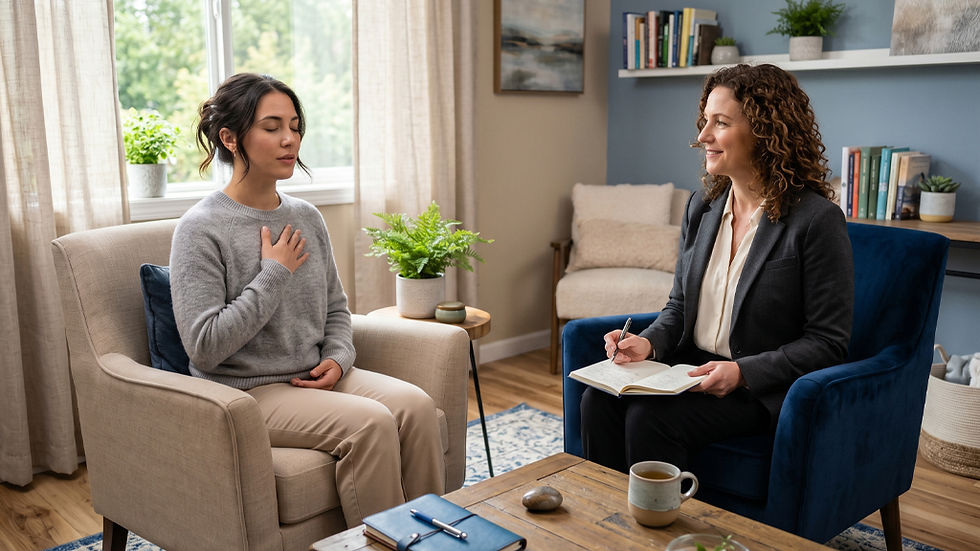
What Is Anxiety and Why Does It Need Professional Attention?
Anxiety is not just stress. It is a chronic state of feeling worried, afraid, and tense, to the extent that you start to have difficulties at work, at home, and in your interactions with others. As reported by the Centre for Addiction and Mental Health (CAMH), anxiety disorders are the most prevalent mental illness in Canada, impacting roughly one in four people at one point in their lifetime.
If left untreated, anxiety symptoms will worsen. You will start avoiding situations, get poor sleep, and keep your body on high alert. Psychotherapy can help break the vicious circle, helping patients deal with both psychological and physiological aspects of anxiety.
How Does Anxiety Therapy Actually Work?
Treatment of anxiety involves tackling the source of anxious thoughts instead of merely treating the symptoms. With the help of a therapist, the triggers responsible for the anxious feelings are recognized and addressed while learning to deal with such negative perceptions and gaining skills that can be used on your own.
If you are wondering what to expect when you first walk in, reading about how therapy for anxiety works and what to expect in your first session can help ease any uncertainty before you begin.
Technique 1: Cognitive Behavioral Therapy (CBT)
CBT is one of the most extensively researched approaches to treating anxiety. It rests on the assumption that there is an interconnectedness between our cognitions, emotions, and actions, and any modifications in these cognitions will automatically affect emotions and actions.
A typical CBT session for treating anxiety would involve the client's identification of automatic negative thoughts and challenging these cognitions with factual evidence. In 2024, a review in the Journal of Anxiety Disorders concluded that CBT is associated with large and sustained decreases in generalized anxiety, social anxiety, and panic disorders. The majority of patients show improvements after 8 to 16 sessions.
Technique 2: Exposure Therapy
Exposure therapy is considered the best treatment when it comes to anxiety disorders involving avoidance. In exposure therapy, the therapist helps you face the things that frighten you gradually and in a very controlled manner, starting from the easiest and progressing to the most difficult scenarios. Ultimately, your body will learn that the scary thing is not going to occur, or, at the very least, that you have learned to cope with it.
This method is particularly useful in overcoming fears, social anxiety, and obsessive behaviors. It should be understood that the goal of this method is not to scare yourself, but to gain the experience that the situation can be endured.
Technique 3: Mindfulness-Based Stress Reduction (MBSR)
MBSR originated in 1979 from the University of Massachusetts by Dr. Jon Kabat-Zinn and currently stands among the most researched methods for addressing anxiety disorders globally. This approach trains clients to notice their cognitions and emotions without responding to them reflexively.
Instead of engaging with your anxious thoughts, MBSR enables you to acknowledge them as phenomena that will eventually subside without any action. A study conducted in 2023 demonstrated that MBSR leads to notable reductions in the levels of anxiety symptoms in various groups of people, such as those experiencing workplace stress, suffering from chronic conditions, or having problems within relationships.
If anxiety is affecting your sleep as well as your daily mood, it is worth understanding how sleep and mental health are deeply connected, since poor rest can significantly worsen anxious symptoms over time.
Technique 4: Diaphragmatic Breathing
The technique of diaphragmatic breathing, alternatively referred to as deep belly breathing, is a physiological process that interferes with the fight-or-flight response. In cases where anxiety levels increase significantly, one starts to breathe faster. Such breathing informs the brain that there is some kind of threat around, thereby triggering even more anxiety.
The slow and deep breathing process engages the parasympathetic nervous system, which is known to be responsible for the relaxation responses. Trained therapists assist their patients in learning how to engage in this process whenever they feel extremely anxious. Just five minutes of practicing diaphragmatic breathing reduces stress hormones.
Technique 5: Acceptance and Commitment Therapy (ACT)
ACT is a relatively new therapeutic technique supported by scientific evidence. Unlike CBT, ACT does not involve disputing the anxious patient's thoughts. Instead, the technique focuses on accepting these thoughts without allowing them to govern the behavior. It aims to clarify one’s values and take steps towards achieving them despite the anxiety.
This method is best for patients who have previously fought with their anxiety and made efforts to repress it; however, it proved futile because it just increased the anxiety level. The efficacy of ACT was confirmed by an article published in the journal Behaviour Research and Therapy. It is often integrated into individual counselling sessions where personalized pacing is essential.
Technique 6: EMDR for Anxiety
EMDR was initially designed for trauma patients but has proven to be very successful in dealing with anxieties resulting from distressing events in one’s past. The treatment involves guiding the client through certain eye movements when recalling their memories or triggers. In some way, it helps the brain process the distress stored in it in such a manner that it no longer elicits a similar fear reaction.
According to a systematic review by Frontiers in Psychology from 2022, EMDR can help alleviate the anxiety symptoms of patients without a prior diagnosis of any trauma. It is particularly effective in situations where there is an element of a specific trigger or incident associated with the anxiety problem.
Technique 7: Behavioral Activation
Behavioral activation therapy is a simple yet effective approach that is based on the association between behavior and mood. The reason for increased anxiety is a withdrawal from the enjoyable activities one used to do, leading to a vicious circle of depression and high anxiety levels. Behavior activation breaks the vicious circle by getting patients involved in enjoyable activities.
Behavioral therapy involves helping patients engage in activities they used to do before, thus breaking the negative pattern of avoidance caused by their anxiety. When anxiety is tied to emotional triggers or stress reactions, it can also help to explore grounding strategies, such as those outlined in this guide on managing emotional triggers, which pairs well with behavioral activation work.
How to Access Anxiety Therapy in Mississauga
Getting started does not have to be complicated or expensive. Anxiety therapy in Mississauga is available in both in-person and virtual formats, making it accessible regardless of your schedule or location. If cost has been a barrier in the past, it is worth knowing that affordable therapy options do exist and are often more accessible than people realize.
You can learn more about how to find affordable therapy that actually works, so that finances do not stand between you and the support you need. Anchored Therapy Centre in Mississauga offers online therapy Mississauga options with no waitlist and no referral required, making it easy to begin when you are ready.
Conclusion
Anxiety therapy isn’t one solution or a “magic trick.” Anxiety therapy is a journey, and your therapist will find the right strategy for you. This could involve anything from CBT to EMDR or mindfulness, but whatever path you choose, each of the 7 therapies discussed in this article is highly researched and backed by the experience of thousands who have successfully overcome anxiety.
If you are ready to take the next step, visit Anchored Therapy Centre to connect with a registered therapist who specializes in anxiety. No referral is needed, and sessions are available in-person and online across Ontario.
FAQs
Q1: What is the most effective technique for anxiety relief?
The most studied technique for dealing with anxiety disorders is CBT, and it is the most recommended form of treatment according to many mental health associations in Canada and internationally. Nonetheless, the most effective therapy program will depend on the nature of the anxiety and individual preference.
Q2: How quickly can I expect anxiety relief from therapy?
There have been cases where patients report improvement after 4 to 8 therapy sessions. According to some research, patients suffering from general or social anxiety tend to experience positive changes after 12 weeks of therapy.
Q3: Is online therapy as effective for anxiety relief as in-person sessions?
Yes. Several studies have shown that the results provided by face-to-face sessions are very much like those of an online therapy program. There are clients who find online therapy in Mississauga more appealing than face-to-face therapy.
Q4: Can I get anxiety relief without medication?
Sure thing. Psychotherapy alone yields long-term anxiety relief for most patients. Methods like cognitive-behavioral therapy, acceptance and commitment therapy, mindfulness-based stress reduction, and exposure therapy are all examples of effective therapies that don’t require medication.
Q5: What should I look for in anxiety therapy in Mississauga?
Choose a licensed psychotherapist with expertise in treating anxiety disorders who will clearly outline their treatment method and offer a comfortable setting where you can express yourself freely. Affordable anxiety therapy and anxiety therapy online in Mississauga are abundant, so financial constraints need not be an issue.